
Iconic
A better way to buy tickets
A digital solution in ticket purchasing
Background
Role
Product Design (UX/UI)
12 weeks - 110+ hours
The mobile ticketing market is experiencing significant growth, driven by the increasing adoption of smartphones and the convenience they offer. In 2024, the global mobile ticketing market is estimated to be worth approximately $2.82 billion and is projected to reach $12.13 billion by 2034, reflecting a compound annual growth rate (CAGR) of 15.7% over the decade.
Problem
Live events venue needs an online mobile application. Customer engagement needs to be more streamlined and accessible. Customers need a way to browse upcoming events, ways to purchase tickets, and manage bookings from the convenience of their mobile phones.
Project Goals
Build a live-music venue online mobile application to enhance operations, customer engagement and revenue potential. Offer convenience and personalization to customers so that they can manage bookings seamlessly from their mobile devices.
Empathize - Understanding the User
Overview
Background
To better understand user frustration, needs, and requirements, I conducted a foundational research through interviews and user surveys for my project. My goal was to gain insights to understand the processes users go through to find and purchase the tickets online through their mobile devices.
Because of the limited time frame I had to work with, I chose to conduct qualitative research rather than quantitative.
The research process had the following goals:
Explore and identify patterns of how users shop for live event tickets for a specific venue.
Identify pain points and hurdles that users encounter when purchasing tickets through a mobile application.
Customer Interviews
I recruited 4 participants who purchased tickets for live venue events within the last several weeks. Along with gaining insight about how they shopped for these tickets, I also inquired about their experiences searching and purchasing tickets for live venue events -- what process they go through to select a specific event, their frustrations throughout the process, and what factors they take into account. The following is a summary of their experiences:
New and Upcoming Shows
All the participants purchase their tickets online or through a mobile application these days. 3 out of 5 of the participants said they like to browse new and upcoming artists through the application when deciding on a prospective artist they may like to see. 2 out of the 5 only preferred purchasing tickets using a search tool for artists they specifically wanted to see instead of browsing.
Shopping and Browsing Habits
A majority of the participants mentioned that having a search bar and filter is important when browsing for certain artists or genres. Most of the participants also mentioned that artists they were looking for needed to have a “set list” in order to discern whether or not a particular song or performance they were expecting would be showing.
Preventing Scalpers and Bots
All the participants agreed that a large hurdle with purchasing popular or high demand artists is that bots and scalpers will quickly snatch up most of the tickets and resell them on third party websites at extravagant premiums. The largest frustration is that many of these scalpers simply flip the tickets for profit and don’t have any interest in actually going to the event.
The biggest takeaway from all the participants is that they when purchasing tickets for live events, more control and a focus on functionality is needed while deterring scalpers and bots from ruining the purchasing process.
Define - Substantiating User Needs
Overview
Developing Persona
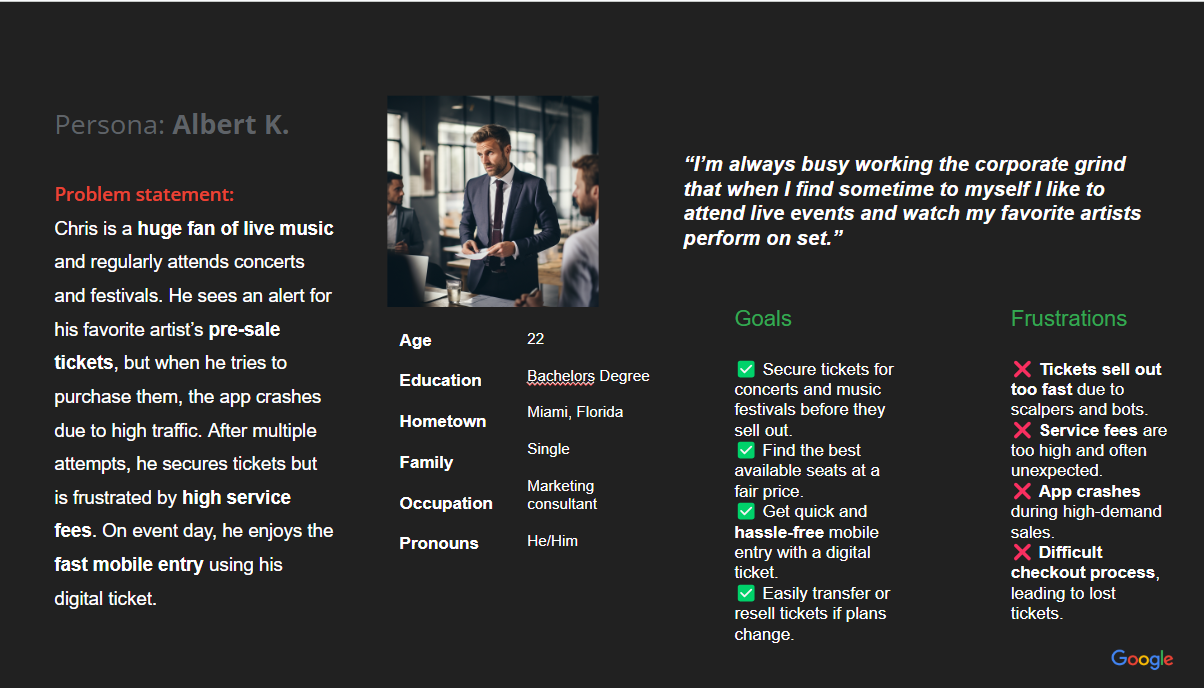
Based on my findings, I observed some trends among my participants. They expressed a desire to explore new live events but often felt uncertain about where to look and whether the artists would match their musical tastes. A significant issue is that when popular artists or in-demand tickets are available, scalpers and bots often swoop in to purchase them all, driving up prices for resale. Additionally, I found that those who enjoy socializing tend to be more eager to attend live events and music venues. This led me to develop a persona named Alberta Krazinski.
Albert is always busy working the corporate grind that when he finds sometime to himself he like to attend live events and watch his favorite artists perform on set
Albert is an avid live music enthusiast and often finds himself at concerts and festivals. He sometimes gets notifications for pre-sale tickets for his favorite artists, but when he attempts to make a purchase, the app crashes due to overwhelming traffic. After several tries, he eventually manages to secure tickets, but he’s left feeling frustrated by the steep service fees and the convoluted check-out process. On the day of the event, however, he appreciates the smooth entry, as he can simply use his digital ticket on his phone without needing to print anything out.
Albert is an avid live music enthusiast and often finds himself at concerts and festivals. He sometimes gets notifications for pre-sale tickets for his favorite artists, but when he attempts to make a purchase, the app crashes due to overwhelming traffic. After several tries, he eventually manages to secure tickets, but he’s left feeling frustrated by the steep service fees and the convoluted check-out process. On the day of the event, however, he appreciates the smooth entry, as he can simply use his digital ticket on his phone without needing to print anything out.
Ideate - Creating the Framework
Ideation
Storyboarding
Ideation
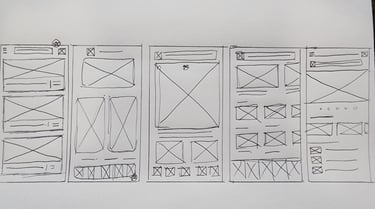
To build on my brainstorming, I began by first taking the ideas that were forming in my research phase. I did rough sketches with interval breaks in between each drawing.


Storyboarding
During my Storyboarding process, I continued to sketch drawings with design layout and functionality aspects into consideration.

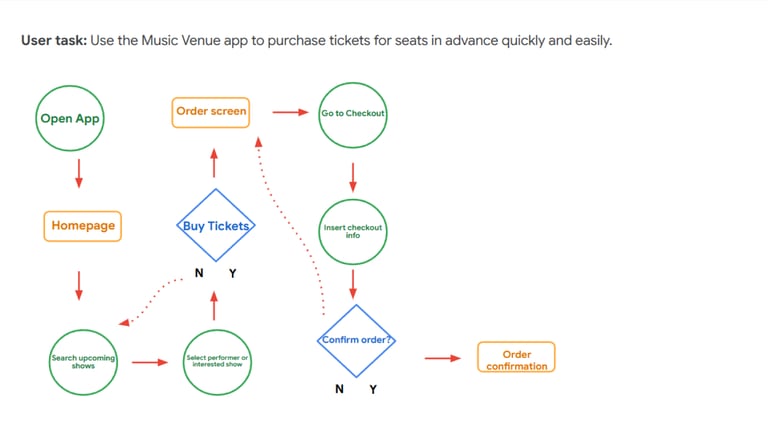
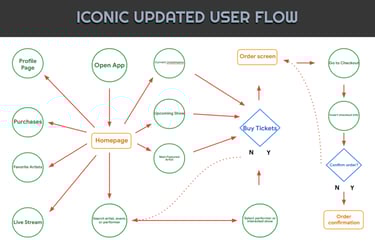
Userflow
Prototyping - Creating the Design
Wireframes
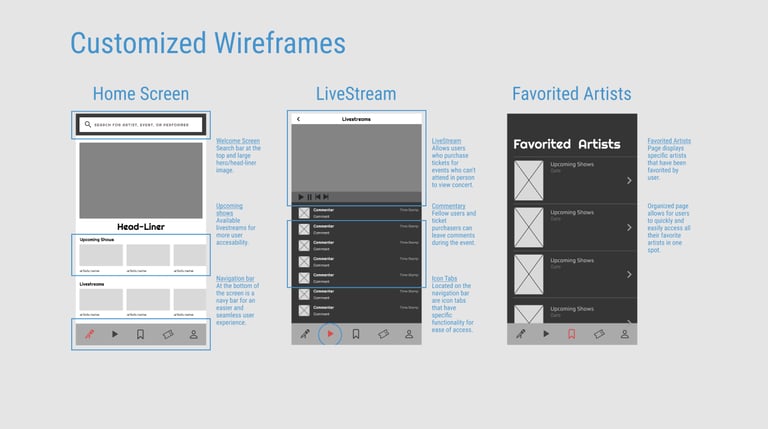
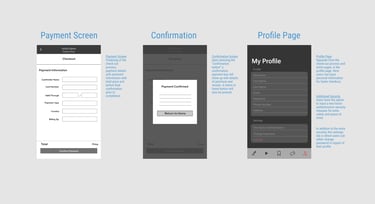
When I was creating my wireframes, I looked at a several other mobile ticketing applications for reference. I wanted to see what type of genres and application components shopping customers felt the most acquainted and familiar with. I noticed a majority of the applications had a filtering system so users can simplify their search and make the process more efficient and seamless.
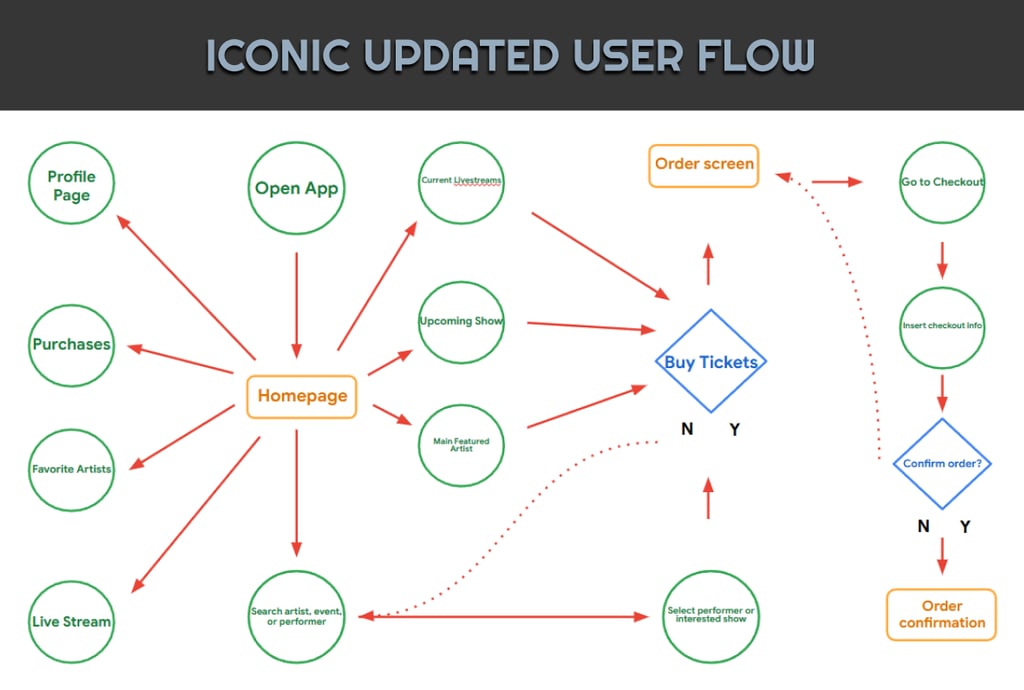
After going through several applications and pinpointing repetitive issues I began working on making a clear navigation so users don’t waste time struggling to find events or ticket types. Also, making sure the check-out process is quick and painless to limit user and customer drop-offs and abandoned carts.
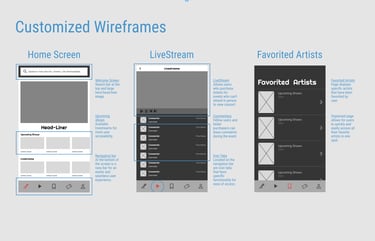
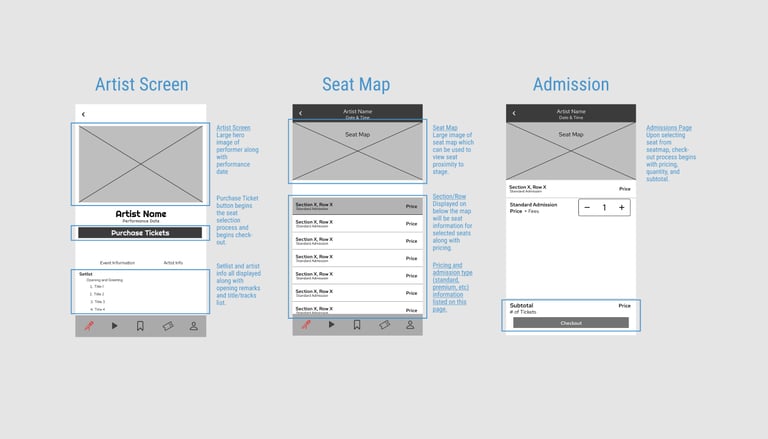
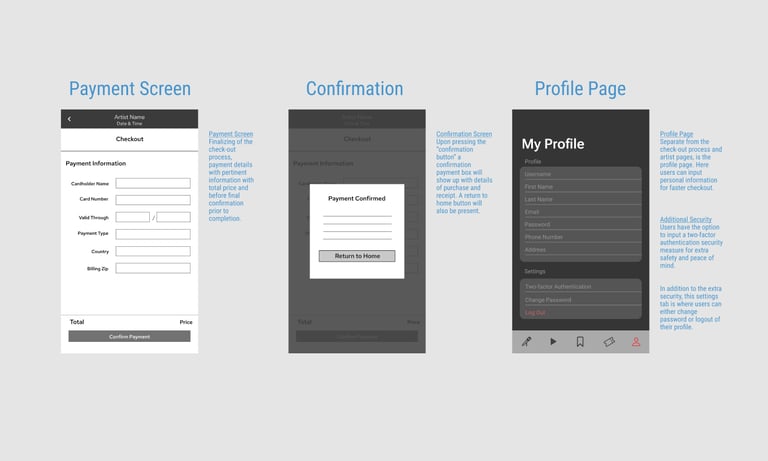
Low Fidelity Prototype Testing
I conducted a test of the low-fidelity prototype with several participants. Many of the concepts I had envisioned during brainstorming didn’t translate as expected. During the testing sessions, I engaged the participants in discussions about their expectations. After the initial run-through of the prototype, I shared the range of ideas I had considered while developing it, in hopes of gathering more constructive feedback.
I had numerous ideas swirling in my mind that I wanted to incorporate into my design. Testing the low-fidelity prototype proved to be invaluable, allowing me to refine my concepts and concentrate on the key elements.
Avoiding Sensory Overload - Many of the participants mentioned they enjoyed the simplicity of the layout and not having too many images and texts all over the homepage.
Search Bar - All participants felt that having the search bar at the top of the homepage made it easy and efficient to quickly search for specific artists they were interested in at the time.
Extra Security - One of the most popular feature which all participants unanimously agreed on was the two-factor authentication add-on for the app. With all the fraud and cyber crime rampant in today’s society, users felt more at ease knowing they could add an additional layer of security.
Branding, Style, and Aesthetics
For this project, I wanted to design a brand and aesthetic that was both modern and relatable to live event enthusiasts. In order to do so, I implemented a monochromatic color scheme with a slight twist and accent.


Final Design


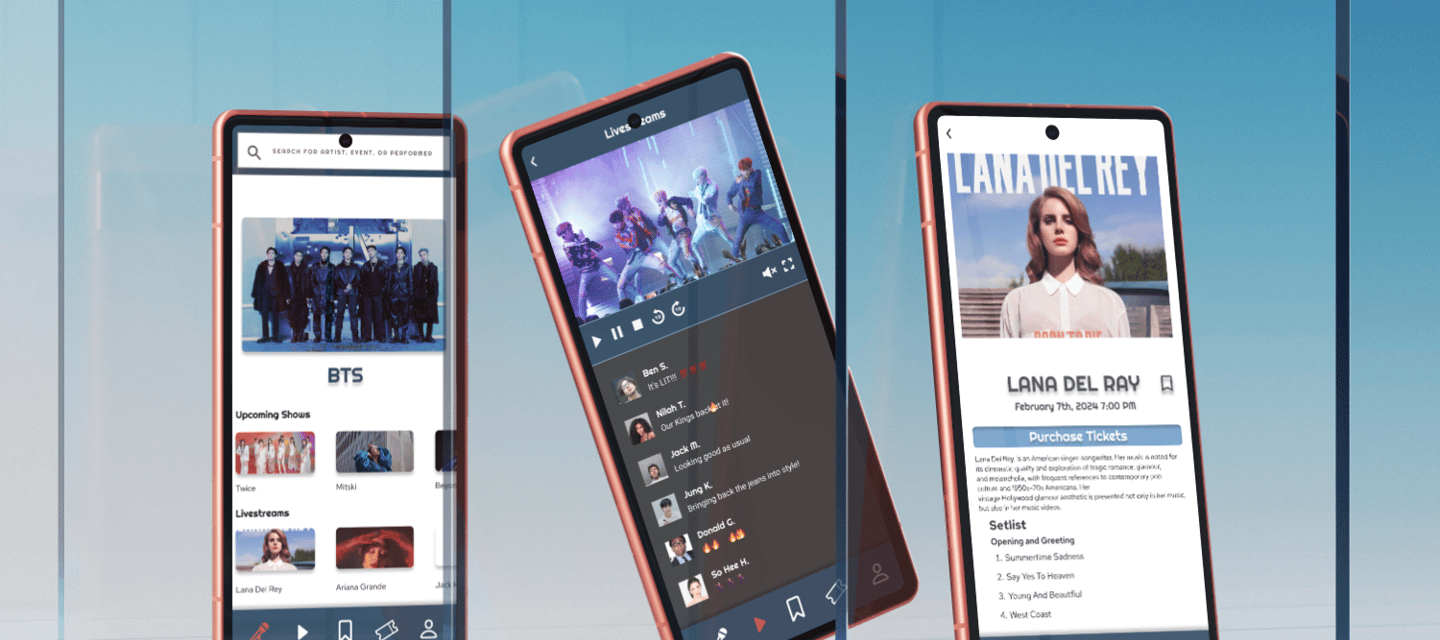
Streaming Screen
Seat Map Selection
Streaming Screen
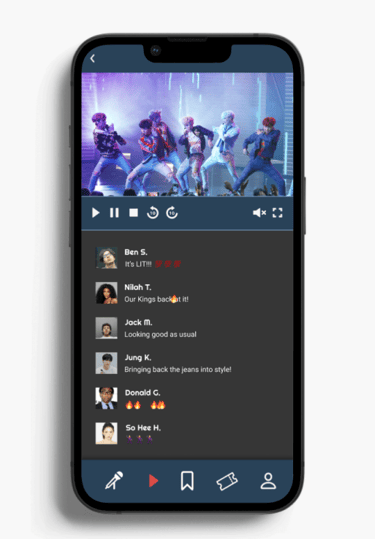
When I was developing the application I wanted it to be accessible to many different communities. In order to do so, I decided to add an inclusive streaming screen for users who can’t physically be at the venue in person of prefer to watch live events through video incorporated with text and captioning.
Furthermore, I wanted users to be able to leave comments and interact with others as a means of building commodore and community.
Users have the option to also play, pause, stop, and rewind the stream.

Seat Map Selection Screen
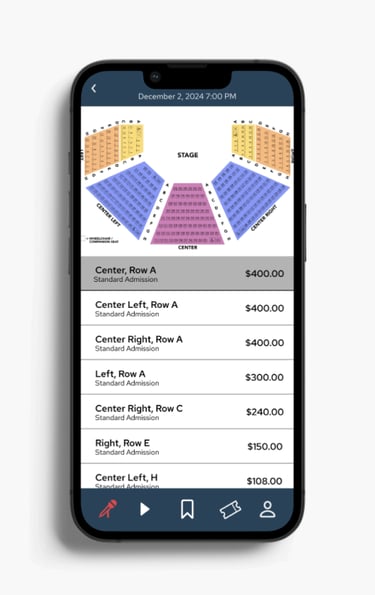
The purpose of having a seat selection screen is to provide complete transparency.
I wanted to empower users to be able to choose exactly where they want to sit giving them more agency in their purchase.
Furthermore, having a visual layout makes for a more intuitive experience rather than selecting from just a list or dropdown. Visualization offers more clarity and transparency.

High-Fidelity Prototype
Testing - Testing the Prototype
Overview
Usability Test Findings
Priority Revisions
Next Steps
Final Design
Usability Test Findings
I tested my high fidelity prototype on five separate participants. Of the five, two of them went in blind trying the application for the first time as they were not active participants during the low fidelity prototype testing. The task for this prototype was to search and shop for a live event through the application. Everyone completed the task.
Overall Experience - The participants said they enjoyed using the application and had no issues checking out from start to finish.
Seat-map - Two participants mentioned that they would’ve liked the seating map to be a big larger and have the ability to zoom in, as it’s hard to see on their small screens.
Profile Wallet - One participant said she would’ve liked to see a wallet or saved form of payment in the profile page to help expedite payment in the future without having to re-enter all of the information.
Customer Support - Two participants mentioned the need for a customer service page or information on customer support. Being able to contact support in case of any issues through email or by phone was important.
Revisions


Figma/Photoshop
Timeline
Tools
Overview
Research Proposal
Customer Interview
Overview
Persona Development
Problem Statements
Overview
Wireframes
Branding
Userflow
UI Design
Final Design